
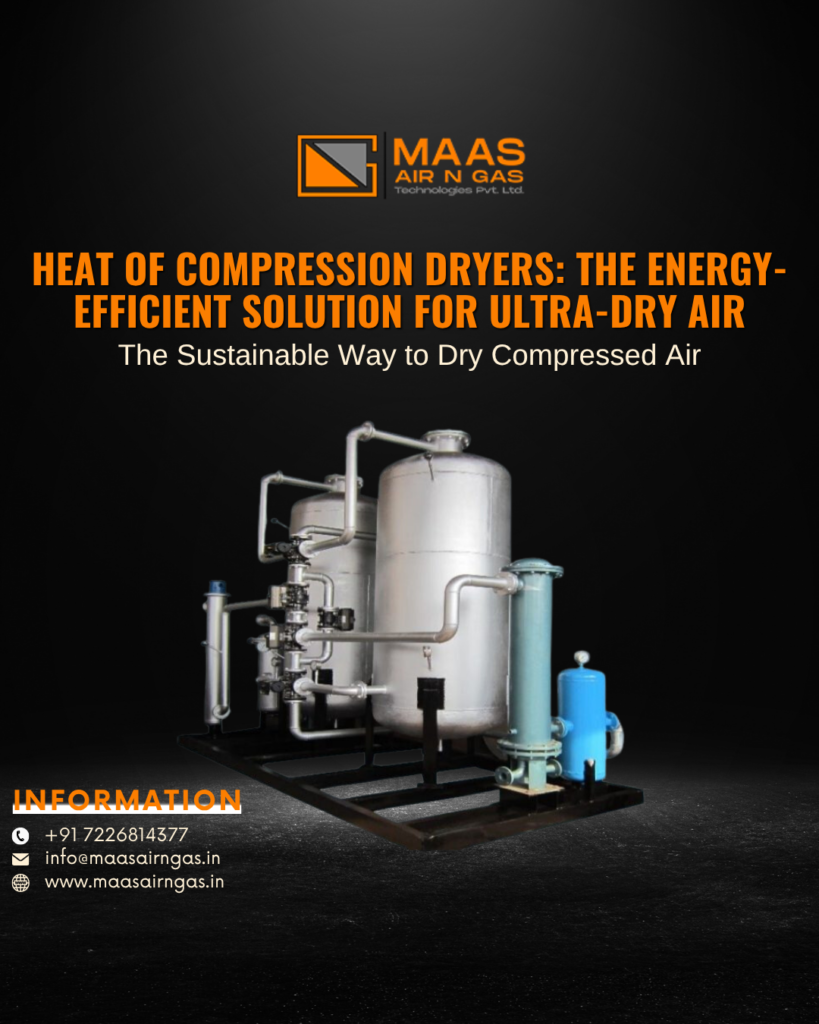
A Heat of Compression Dryer (HOC Dryer) is an industrial compressed-air drying system that uses the heat generated during compression to regenerate the desiccant. Instead of relying primarily on conventional purge air or a separate electrical heater for regeneration, the system can utilize heat available from an oil-free compressor. This makes Heat of Compression technology an important option for industries looking to improve compressed-air utilization and reduce unnecessary energy consumption.
The uploaded MAAS Air N Gas image presents the system as “Heat of Compression Dryers: The Energy-Efficient Solution for Ultra-Dry Air” and highlights sustainable compressed-air drying. MAAS Air N Gas explains that its HOC Air Dryer uses heat generated in non-lubricated compressors for desiccant regeneration. Its published information also highlights no purging losses, electrical heater load savings, dew point capability down to -60°C, and suitability from 400 CFM onwards.
This detailed guide explains the working principle, features, benefits, applications, energy-efficiency considerations, components, maintenance, selection factors and frequently asked questions related to Heat of Compression Dryers.
Table of Contents
- Introduction
- What Is a Heat of Compression Dryer?
- Why Is Compressed-Air Drying Important?
- How Does a Heat of Compression Dryer Work?
- Working Process of an HOC Dryer
- Key Features of Heat of Compression Dryer
- Benefits of Heat of Compression Drying
- Heat of Compression Dryer vs Conventional Dryers
- Industrial Applications
- Energy Efficiency and Cost Considerations
- Major Components
- How to Select the Right HOC Dryer
- Installation and Maintenance
- Why Choose MAAS Air N Gas?
- Frequently Asked Questions
- Conclusion
Introduction
Compressed air is one of the most widely used utilities in industrial plants. It is required for pneumatic equipment, automation systems, control instruments, manufacturing processes and many other applications. However, compressed air naturally contains moisture, and this moisture can become a serious concern when air is compressed and subsequently cooled.
If moisture is not properly removed, it can enter compressed-air pipelines and downstream equipment. Depending on the application, this can contribute to corrosion, malfunction of pneumatic equipment, contamination and process-related problems.
This is why industrial compressed-air systems often require an appropriate air-drying solution.
A Heat of Compression Dryer takes a different approach to desiccant regeneration. Instead of wasting the useful heat generated during compression, the system utilizes this heat as part of the regeneration process.
MAAS Air N Gas explains that heat generated in non-lubricated air compressors, which can otherwise be lost through cooling, is used to heat air for desiccant regeneration in its Heat of Compression Air Dryer.
This approach can be particularly relevant for facilities using suitable oil-free or non-lubricated compressors and requiring continuous dry compressed air.
What Is a Heat of Compression Dryer?
Basic Definition
A Heat of Compression Dryer, commonly called an HOC Dryer, is a type of desiccant compressed-air dryer that uses heat generated during air compression to regenerate the desiccant.
During compression, air becomes hot. In a conventional system, a significant portion of this heat may be removed through cooling. HOC technology uses suitable available compression heat as part of the regeneration process.
The fundamental idea is therefore:
Compression → Heat Generation → Heat Utilization → Desiccant Regeneration → Dry Compressed Air
MAAS Air N Gas states that its HOC Air Dryer uses heat generated in non-lubricated air compressors for regeneration and describes hot compressed air being heated to approximately 180°C before being passed through the desiccant bed for regeneration.
Why the technology is important
The main advantage of this approach is that the system can make use of heat that is already generated during compression rather than depending entirely on an additional electrical heating source.
According to MAAS, its HOC dryer provides:
- No purging losses
- Electrical heater load savings
- Dew point capability down to approximately -60°C
- Cost-effective operation from 400 CFM onwards, according to its published product information
Why Is Compressed-Air Drying Important?
Moisture in Compressed Air
Atmospheric air naturally contains water vapor. When air is compressed, its temperature and moisture behavior change. As compressed air cools, water vapor can condense and create liquid moisture.
This moisture can then travel through compressed-air piping if the treatment system is not properly designed.
Problems Associated With Moisture
Excessive moisture can create several operational issues:
- Corrosion inside compressed-air pipelines
- Problems with pneumatic equipment
- Malfunction of valves and actuators
- Reduced reliability of instrumentation
- Moisture entering manufacturing processes
- Increased maintenance requirements
- Potential product-quality problems in sensitive applications
The required level of drying depends on the application. Not every plant requires the same pressure dew point, so dryer selection should be based on actual process requirements.
How Does a Heat of Compression Dryer Work?
Heat Utilization Principle
The operating principle of a Heat of Compression Dryer is based on utilizing the heat generated by an appropriate compressor.
When air is compressed, substantial heat is generated. In a suitable HOC arrangement, this hot compressed air is directed through the regeneration circuit.
The heat helps remove moisture from the desiccant bed that has previously adsorbed water vapor.
MAAS describes its process as using hot compressed air through a heater to maintain approximately 180°C before passing it through the desiccant bed for regeneration. The regenerated air is subsequently cooled, moisture is separated and drained, and the cooled air is then sent through the desiccant tower for drying.
Two-Tower Drying Concept
Like many adsorption-based dryers, an HOC system can use multiple desiccant towers.
One tower is responsible for drying while another tower undergoes regeneration. After the regeneration cycle, the system changes the operating configuration.
This allows continuous drying while regeneration is performed on the other side.
Working Process of an HOC Dryer
Step 1: Compression
The compressor compresses atmospheric air. During this process, the compressed air becomes hot.
Step 2: Heat Utilization
The heat generated during compression is utilized as part of the regeneration process.
This is the central feature of Heat of Compression technology.
Step 3: Regeneration
Hot air passes through the desiccant bed that has accumulated moisture. The heat helps remove the moisture from the desiccant.
Step 4: Cooling
After regeneration, the hot air is cooled through an after-cooler arrangement.
Step 5: Moisture Separation
As the air cools, moisture can condense. A moisture separator can collect the condensed water so it can be removed from the system.
Step 6: Drying
The conditioned air is directed through the desiccant drying section, where moisture is adsorbed to achieve the required dryness.
Step 7: Automatic Cycling
The drying and regeneration functions alternate between the available desiccant sections so that continuous operation can be maintained.
Key Features of Heat of Compression Dryer
Heat-Based Regeneration
The most important feature is the use of available compression heat for desiccant regeneration.
This can reduce dependence on separate energy sources for regeneration, depending on the system configuration.
No Conventional Purging Loss
MAAS specifically lists “There will be no purging losses” among the features of its Heat of Compression Air Dryer.
This is important because compressed air used as purge air represents air that has already consumed compressor energy but is not available for the main production process.
Electrical Heater Load Savings
MAAS also highlights electrical heater load savings as a product feature.
The actual energy benefit depends on the compressor, operating conditions and complete system configuration.
Ultra-Dry Air Capability
MAAS states that its HOC dryer can produce a dew point of approximately -60°C under the stated product conditions.
The required dew point should always be selected according to the actual application.
Industrial Construction
The supplied image shows a skid-mounted industrial system with large vessels, piping, valves and associated equipment.
Continuous Drying
The use of separate drying and regeneration functions allows the dryer to support continuous compressed-air treatment.
Benefits of Heat of Compression Drying
Better Utilization of Compressor Heat
One of the biggest advantages of HOC technology is that it uses heat already generated during compression.
Instead of treating this heat only as waste that needs to be removed, the dryer can utilize it for desiccant regeneration.
Reduced Purge-Air Consumption
Conventional regenerative dryers can use a portion of compressed air for regeneration. An HOC configuration can avoid this type of conventional purge consumption, depending on system design.
This means more of the compressor’s output can remain available for the industrial process.
Reduced Additional Heating Requirement
Because compression heat is utilized, the requirement for a separate electrical heating load can be reduced. MAAS specifically identifies electrical heater load savings as a feature of its HOC dryer.
Suitable for Continuous Industrial Operation
Industries that require compressed air continuously can benefit from a drying system designed for continuous operation.
High Dryness Capability
For applications requiring very dry compressed air, HOC technology can provide low dew-point performance when correctly designed and operated.
Potential Operating-Cost Benefits
The combination of heat utilization, reduced purge consumption and lower additional heating requirements can contribute to improved operating economics.
Actual savings should be calculated based on the compressor type, airflow, operating hours, electricity costs and dryer configuration.
Heat of Compression Dryer vs Conventional Dryers
Different dryer technologies use different regeneration methods. Therefore, the right technology depends on the compressor and application.
| Parameter | Heat of Compression Dryer | Conventional Purge-Regenerated Dryer |
|---|---|---|
| Regeneration approach | Uses compression heat | May use compressed-air purge |
| Purge-air consumption | Designed to avoid conventional purge loss | Can consume product air |
| Additional heating | Can reduce separate heater requirement | Depends on dryer design |
| Compressor suitability | Particularly relevant to suitable oil-free/non-lubricated compressors | Wider range of configurations |
| Energy approach | Reuses available compression heat | May require additional compressed air or heat |
| Dew-point requirement | Can support very dry air | Depends on dryer type |
| Application | Industrial continuous drying | Broad industrial applications |
This comparison is a general technology comparison. Actual performance depends on the specific dryer design and operating conditions.
Industrial Applications of Heat of Compression Dryers
Manufacturing Industries
Manufacturing plants use compressed air for pneumatic equipment, automation, tools and control systems. Dry air can help support reliable operation of these systems.
Chemical Processing
Chemical plants often use compressed air for instrumentation, automation and process-related equipment. Moisture control can be important where dry air is required.
Pharmaceutical Manufacturing
Pharmaceutical applications can have strict requirements for process conditions and air quality. The dryer must be selected according to the specific application and applicable standards.
Automotive Manufacturing
Compressed air is widely used in automotive manufacturing for pneumatic equipment, automation, assembly and production processes.
Electronics Manufacturing
Sensitive manufacturing environments can require carefully controlled compressed air. The appropriate treatment system depends on process requirements.
Instrument Air
Instrumentation and control systems can require dry compressed air for reliable operation. Appropriate pressure dew point selection is important.
Other potential applications include:
- Food and beverage processing
- Metal processing
- Packaging
- Textile manufacturing
- Pneumatic automation
- General engineering
- Industrial process plants
Energy Efficiency and Cost Considerations
Why Compression Heat Matters
Compressors consume electrical energy to raise air pressure. A significant amount of energy is converted into heat during compression.
If that heat is simply rejected, the plant loses an opportunity to use it. HOC technology is designed around recovering and utilizing suitable compression heat for regeneration.
No-Purge Operation
Purge air is compressed air that has already required compressor energy. If it is used for regeneration and then discharged, it represents an operating loss.
An HOC dryer designed without conventional purge consumption can therefore preserve more of the compressed air for production.
Important Factors Affecting Savings
Actual energy savings cannot be determined from the dryer name alone. They depend on:
- Compressor type
- Compressor capacity
- Airflow
- Operating pressure
- Compressor operating temperature
- Operating hours
- Required dew point
- Ambient conditions
- Dryer configuration
- Maintenance condition
For this reason, a site-specific energy calculation is recommended when comparing dryer technologies.
Major Components of a Heat of Compression Dryer
Desiccant Towers
The towers contain the drying material that adsorbs moisture from compressed air.
Regeneration Circuit
The regeneration circuit directs suitable hot air through the saturated desiccant bed.
Heating Arrangement
Depending on the system configuration, a heater can be part of the temperature-control arrangement. MAAS describes maintaining approximately 180°C before regeneration in its published HOC dryer description.
After Cooler
The regeneration air is cooled after the regeneration process.
Moisture Separator
Cooling can cause moisture to condense. The moisture separator helps remove this collected water.
Valves and Piping
The valve and piping arrangement controls the flow between drying, regeneration and cooling sections.
Control System
Automatic controls manage the operating sequence, switching and monitoring of the dryer.
How to Select the Right HOC Dryer
Determine Airflow
The first step is to determine the actual compressed-air requirement. Normal and peak demand should both be considered.
Check Compressor Type
HOC technology is particularly associated with heat generated by suitable oil-free or non-lubricated compressors. The compressor and dryer must therefore be evaluated together.
Determine Required Dew Point
Different processes require different levels of dryness.
The required pressure dew point should be established before choosing the dryer.
Consider Operating Hours
For plants operating continuously, energy utilization becomes particularly important when comparing drying technologies.
Evaluate Installation Conditions
Available space, ambient temperature, cooling requirements, piping arrangement and utility availability should be considered.
Consider Future Expansion
If production capacity is expected to increase, the dryer should be evaluated against future airflow requirements.
Installation and Maintenance
Installation Considerations
Correct installation is essential for maintaining dryer performance. Piping should be properly sized, connections should be checked, and the dryer should operate within its specified pressure and temperature range.
The compressor, after-cooler, filters and dryer should be treated as one integrated compressed-air system.
Maintenance Requirements
Regular maintenance helps maintain drying performance and reliability.
Important maintenance activities can include:
- Checking valves and piping
- Monitoring pressure and temperature
- Checking pressure dew point
- Inspecting moisture separators
- Checking condensate drainage
- Inspecting filters
- Monitoring desiccant condition
- Checking control-panel operation
- Inspecting switching valves
- Recording operating parameters
Any maintenance schedule should follow the manufacturer’s recommendations and actual site conditions.
Why Choose MAAS Air N Gas?
MAAS Air N Gas Technologies Pvt. Ltd. provides industrial air and gas treatment solutions, including air dryers, gas dryers and gas-generation technologies.
The company specifically lists a Heat of Compression Air Dryer and explains that the system uses heat generated by non-lubricated compressors for desiccant regeneration. Its published product information highlights no purging losses, electrical heater load savings and low dew-point capability.
MAAS also provides other industrial drying technologies, allowing dryer selection to be based on the compressor type and application rather than using a single technology for every plant.
For an HOC dryer project, important technical parameters should be discussed before final equipment selection, including airflow, pressure, inlet temperature, compressor type, dew point requirement and operating hours.
Frequently Asked Questions
What is a Heat of Compression Dryer?
A Heat of Compression Dryer is a desiccant air dryer that uses heat generated during the compression process to regenerate the drying material.
What does HOC stand for?
HOC stands for Heat of Compression.
How does an HOC dryer save energy?
It can utilize heat generated during compression for desiccant regeneration, reducing dependence on additional heating and conventional purge-air consumption, depending on the system configuration.
Does an HOC dryer use purge air?
MAAS states that its Heat of Compression Air Dryer has no purging losses as a product feature.
What dew point can a Heat of Compression Dryer achieve?
MAAS states that its HOC dryer can produce a dew point of approximately -60°C under its published product conditions.
What type of compressor is suitable for an HOC dryer?
HOC technology is particularly associated with heat generated by oil-free or non-lubricated compressors. The compressor and dryer should be technically matched before installation.
Is an HOC dryer suitable for continuous operation?
It can be suitable for continuous industrial compressed-air applications when correctly sized and configured for the operating conditions.
What is the main advantage of an HOC dryer?
Its main design advantage is the utilization of compression heat for regeneration, which can reduce conventional purge-air consumption and additional heating requirements.
Is a Heat of Compression Dryer suitable for every plant?
No single dryer technology is suitable for every application. Compressor type, airflow, pressure, inlet temperature, required dew point and operating conditions should be evaluated before selection.
Does MAAS Air N Gas provide Heat of Compression Dryers?
Yes. MAAS Air N Gas lists Heat of Compression Air Dryers as part of its industrial dryer solutions.
Conclusion
A Heat of Compression Dryer provides an energy-conscious approach to compressed-air drying by utilizing heat generated during the compression process for desiccant regeneration. Instead of allowing useful compression heat to be completely rejected, the HOC concept puts that heat to work in the drying cycle.
The technology can be particularly relevant for industrial facilities using suitable non-lubricated or oil-free compressors and requiring reliable, very dry compressed air. https://www.india.gov.in/
The key advantages highlighted by MAAS Air N Gas include no purging losses, electrical heater load savings, low dew-point capability and cost-effective operation from 400 CFM onwards, according to its published product information.
However, the correct dryer should always be selected according to actual plant conditions. Airflow, compressor type, operating pressure, inlet temperature, required dew point, operating hours and future capacity requirements should all be considered.
Leave A Comment